
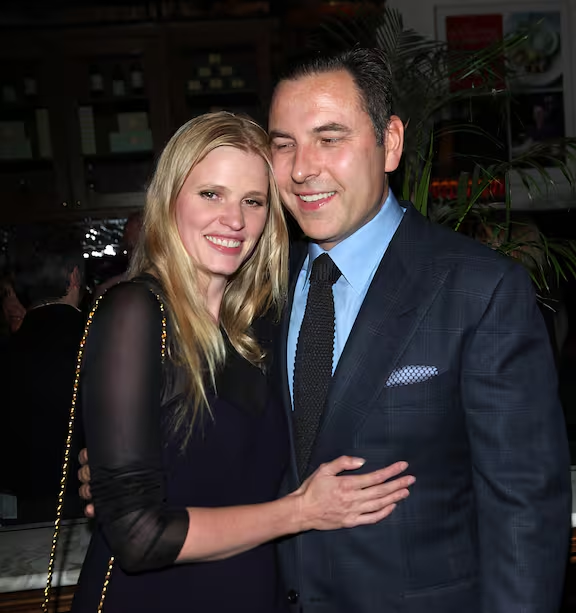
David Walliams wife news continues to spark public interest, not because of fresh romantic developments, but because of how carefully the comedian has managed his private narrative since his split from model Lara Stone. The question itself reveals more about audience appetite for celebrity relationship updates than it does about Walliams’ current status, which remains single and deliberately low-profile.
Understanding why this search persists offers insight into how celebrity relationship cycles work, how privacy strategies evolve after high-profile splits, and why some public figures actively resist the remarriage narrative.
The Signals Behind Persistent Interest and Search Volume
The sustained search for David Walliams wife news demonstrates a pattern familiar to anyone tracking celebrity attention cycles. Walliams divorced Lara Stone following a five-year marriage that ended amid claims of unreasonable behaviour, and the lack of a subsequent high-profile relationship has created a vacuum that search engines reflect.
From a practical standpoint, this creates ongoing speculation despite no concrete developments. The comedian has been linked romantically to several women, including Ashley James, Kate Beckinsale, and Emily Agnes, but none of these connections evolved into confirmed long-term partnerships.
What actually drives continued interest is the absence of closure in the public narrative. Walliams shares a son, Alfred, with his ex-wife, who has since remarried property developer David Grievson. That contrast between his ex-wife’s new chapter and his apparent single status fuels curiosity and repeat searches.
Privacy Strategy as Reputational Risk Management Tool
Look, the bottom line is that Walliams has deployed a textbook privacy-first strategy since the divorce. Unlike celebrities who use new relationships as PR leverage, he has kept romantic interests firmly out of the media cycle, understanding that overexposure invites scrutiny he no longer wants.
This approach carries trade-offs. It protects personal boundaries but also leaves space for speculation and rumour to fill the gaps. The data tells us that audiences interpret silence differently: some read it as respect for his son’s privacy, others as evasiveness.
From what I’ve seen play out in similar situations, this strategy works best when paired with controlled professional visibility. Walliams maintains a strong career presence through his children’s books and television work, which keeps his name relevant without requiring personal disclosure.
Narrative Pressure and the Marriage Pact Disclosure
Interestingly, Walliams himself introduced one element into the public conversation that subtly redirected attention: his lighthearted marriage pact with actress Sheridan Smith. He described an agreement to marry each other if both remain single at age ninety, framing it as a joke between friends.
Here’s what actually works about that move: it acknowledges the marriage question without promising anything, and it positions future partnership as something distant and non-urgent. The reality is that this kind of playful deflection can reduce pressure while maintaining likability.
The marriage pact comment also signals comfort with his current status. It suggests he’s not actively seeking to replicate his previous relationship structure, at least not on the public’s timeline. That’s a positioning choice, and it’s one that reflects confidence in navigating attention without conforming to expected patterns.
Audience Psychology and the Expectation Cycle
What I’ve learned from watching these dynamics is that audiences often expect celebrities to follow predictable relationship arcs: marriage, potential split, remarriage. When someone breaks that pattern by remaining single longer than anticipated, it creates cognitive dissonance that manifests as repeated searches.
Walliams has been single for nearly a decade since his divorce, which sits outside the typical timeline for high-profile figures. This deviation from the norm doesn’t suggest anything negative about his personal life, but it does explain why the question persists.
The bottom line is that search behaviour reflects unmet expectations more than actual news. People return to the query hoping for an update that confirms the expected arc has resumed. When it doesn’t, the cycle repeats.
Media Economics and the Cost of Speculation
From a media standpoint, David Walliams wife news generates reliable traffic despite offering little substance. Publishers understand that relationship status queries perform well in search, particularly when tied to recognisable names, so they continue producing speculative content even when no developments warrant coverage.
This creates a feedback loop: search demand encourages content production, which reinforces the impression that there’s something to know, which drives further searches. It’s a market inefficiency built on information asymmetry, and it works because audiences can’t always distinguish between news and noise.
What actually matters here is recognising when a story has reached its natural endpoint. Walliams has made clear through his actions that his romantic life is not public content. The continued search for updates reflects audience curiosity, but it doesn’t create an obligation for disclosure. That distinction matters, both for understanding media cycles and for evaluating what constitutes legitimate public interest versus invasive speculation.

Previous Article
Unique Custom Stickers That Make Your Items PopNext Article
Simon Cowell wife news